
Yangtian Zhang
Ph.D. student in Computer Science, Yale University · advised by Rex Ying & David van Dijk
I study generative models for discrete and non-Euclidean data — sequences, permutations, and geometric structures — and how to steer them with reinforcement learning and distillation.
t = 0
01About
I'm a Ph.D. student in Computer Science at Yale, co-advised by Prof. Rex Ying and Prof. David van Dijk. Before Yale I worked with Prof. Jian Tang at Mila on geometric generative modeling, and I hold a B.Eng. in Computer Science from the ACM Honors Class at Shanghai Jiao Tong University.
My research is on generative modeling, mostly diffusion and flow models for discrete and structured data: discrete diffusion for language that conditions on its whole trajectory (CaDDi), diffusion over permutations via reflected soft ranks (Soft-Rank Diffusion), and, in earlier work, geometric models on the torus and in SE(3) (DiffPack, E3Bind).
I'm equally interested in steering and accelerating these models. I've used policy gradients to learn a model's own generation order (ICML'26 Spotlight), RL to post-train LLMs to refine sequences through verifiable edits (STRIDE) and to co-train specialized LoRA experts in multi-agent LLM systems (MoRSE), and at Meta I'm working on distilling diffusion language models for efficient generation.
02News
- MoRSE, a multi-agent LLM system with role-subtask LoRA experts trained by hierarchical RL, accepted at NeurIPS 2026.
- Joining Meta as a Research Scientist Intern this summer, working with Dr. Fei Sha in Menlo Park.
- Three papers at ICML 2026. Variational Learning for Insertion-based Generation is a Spotlight (top 2.2%); Soft-Rank Diffusion and STRIDE were also accepted.
- CoPersona accepted at KDD 2026.
- CaDDi accepted at NeurIPS 2025. See you in San Diego!
- Joining Google DeepMind as a Student Researcher in New York.
- FlowCF accepted at KDD 2025.
- Our survey on diffusion models for recommender systems is online.
- DiffPack accepted at NeurIPS 2023.
- E3Bind accepted at ICLR 2023.
- We released TorchDrug, a machine learning platform for drug discovery.
03Publications
-
Variational Learning for Insertion-based Generation
Yangtian Zhang*, Zhe Wang*, Arthur Gretton, Rex Ying, David van Dijk, Michalis Titsias, Jiaxin Shi (*equal contribution)
Treat the generation order as a latent variable. Tokens are inserted anywhere, the order is learned by variational inference, and left-to-right AR and discrete diffusion fall out as special cases.
We introduce a variational learning framework for insertion-based generation, where sequences are constructed via a learned-order autoregressive process that dynamically selects insertion positions. By formulating the generation order as a latent variable, our method enables flexible-length sequence construction and unifies left-to-right autoregression with discrete diffusion under a single principled framework.@article{zhang2026insertion, title={Variational Learning for Insertion-based Generation}, author={Zhang, Yangtian and Wang, Zhe and Gretton, Arthur and Ying, Rex and van Dijk, David and Titsias, Michalis and Shi, Jiaxin}, journal={International Conference on Machine Learning (ICML), Spotlight (top 2.2\%)}, year={2026} } -
Learning Permutation Distributions via Reflected Diffusion on Ranks
Sizhuang He*, Yangtian Zhang*, Shiyang Zhang, David van Dijk (*equal contribution)
Soft-Rank Diffusion. Lift a permutation to continuous soft ranks, diffuse them with reflection at the boundaries, and denoise with contextual Plackett–Luce heads.
We propose Soft-Rank Diffusion, a discrete diffusion framework for learning probability distributions on the finite symmetric group. Rather than relying on shuffle-based random walks, we lift permutations to a continuous latent representation of order and define a structured soft-rank forward process. We further introduce contextualized generalized Plackett-Luce (cGPL) denoisers for the reverse process, enabling flexible and stable generative modeling of permutation distributions with applications to ranking and combinatorial structure learning.@article{he2026permutation, title={Learning Permutation Distributions via Reflected Diffusion on Ranks}, author={He, Sizhuang and Zhang, Yangtian and Zhang, Shiyang and van Dijk, David}, journal={International Conference on Machine Learning (ICML)}, year={2026} } -
STRIDE: Post-Training LLMs to Reason and Refine Bio-Sequences via Edit Trajectories
Daiheng Zhang, Shiyang Zhang, Sizhuang He, Yangtian Zhang, Syed Asad Rizvi, David van Dijk
An LLM that writes its reasoning as an executable chain of INSERT / DELETE / REPLACE edits, trained with SFT on shortest edit paths and then RL.
STRIDE (Sequence Trajectory Refinement via Internalized Denoising Emulation) is a post-training framework that trains an LLM to emit executable trajectories of atomic edits (INSERT/DELETE/REPLACE) as a verifiable reasoning trace for variable-length refinement. STRIDE combines supervised fine-tuning on Levenshtein-aligned shortest edit demonstrations with group-based policy optimization to align edit trajectories with task rewards while preserving coherent editing behavior. STRIDE improves variable-length protein editing success from 42% to 89% while increasing novelty from 47% to 97%, and yields stronger validity and controllability compared to diverse baselines.@article{zhang2026stride, title={STRIDE: Post-Training LLMs to Reason and Refine Bio-Sequences via Edit Trajectories}, author={Zhang, Daiheng and Zhang, Shiyang and He, Sizhuang and Zhang, Yangtian and Rizvi, Syed Asad and van Dijk, David}, journal={International Conference on Machine Learning (ICML)}, year={2026} } -
CoPersona: Collaborative Persona Graphs for Robust LLM Personalization
Yangtian Zhang*, Leyao Wang*, Hiren Madhu, Ngoc Bui, Walter Roznyatovskiy, Rex Ying (*equal contribution)
Sparse user histories leave facets of a persona unobserved. Split each history into facets, link peers facet-by-facet in a multiplex graph, and borrow what is missing.
Real-world LLM personalization is often constrained by sparse and skewed user histories. CoPersona is a graph-based collaborative personalization framework that completes sparse user profiles by borrowing signals from behaviorally similar peers. It decomposes interaction histories into facet-level representations and explicitly models peer-to-peer, facet-level alignment through a multiplex persona graph, then combines non-parametric peer retrieval with parametric graph reasoning at inference time. Experiments across multiple domains and model scales demonstrate consistent improvements over strong baselines.@article{zhang2026copersona, title={CoPersona: Collaborative Persona Graphs for Robust LLM Personalization}, author={Zhang, Yangtian and Wang, Leyao and Madhu, Hiren and Bui, Ngoc and Roznyatovskiy, Walter and Ying, Rex}, journal={ACM SIGKDD Conference on Knowledge Discovery and Data Mining}, year={2026} } -
MoRSE: Task-Oriented Multi-Agent System with Mixture of Role-Subtask Experts
Peiwen Li, Shiyang Zhang, Yangtian Zhang, Sizhuang He, David van Dijk, Rex Ying
A task becomes a DAG of (role, subtask) agents on one shared LLM, each routed to its own LoRA expert; hierarchical group-relative policy optimization credits experts and router separately under a single sparse reward.
Large language model-based multi-agent systems have shown strong potential for complex, long-horizon tasks, but existing methods mainly rely on coarse prompt-level differentiation without parameter adaptation, limiting inter-agent heterogeneity and specialized capability. MoRSE distinguishes agents with (role, subtask)-conditional specialization at both the task-structure and parameter levels. It decomposes each task into a dependency-aware DAG of subtasks and assigns each agent a specific (role, subtask); a dynamic Mixture of (role, subtask) LoRA Experts with a prototype-based semantic router adds parameter-level specialization on a shared LLM cost-effectively. To co-optimize experts and router stably under sparse task rewards, a hierarchical group-relative policy optimization with two-layer credit assignment isolates expert updates from the variance introduced by routing decisions. Experiments on code-generation benchmarks across three backbones show improvements in both whole-task and step-wise performance, and the gains generalize to held-out task categories and domains.@article{li2026morse, title={MoRSE: Task-Oriented Multi-Agent System with Mixture of Role-Subtask Experts}, author={Li, Peiwen and Zhang, Shiyang and Zhang, Yangtian and He, Sizhuang and van Dijk, David and Ying, Rex}, journal={Advances in Neural Information Processing Systems}, year={2026} } -
Non-Markovian Discrete Diffusion with Causal Language Models
Yangtian Zhang*, Sizhuang He*, Daniel Levine, Lawrence Zhao, David Zhang, Syed A Rizvi, Emanuele Zappala, Rex Ying, David van Dijk (*equal contribution)
CaDDi. Each denoising step conditions on the entire trajectory, not just the last state, so a causal LM can run discrete diffusion and reuse pretrained weights unchanged.
Discrete diffusion models offer a flexible, controllable approach to structured sequence generation, yet they still lag behind causal language models in expressive power. A key limitation lies in their reliance on the Markovian assumption, which restricts each step to condition only on the current state, leading to potential uncorrectable error accumulation. We introduce CaDDi, a discrete diffusion model that conditions on the entire generative trajectory, thereby lifting the Markov constraint and allowing the model to revisit and improve past states. By unifying sequential (causal) and temporal (diffusion) reasoning in a single non-Markovian transformer, CaDDi also treats standard causal language models as a special case and permits the direct reuse of pretrained LLM weights with no architectural changes. Empirically, CaDDi outperforms state-of-the-art discrete diffusion baselines on natural-language benchmarks, substantially narrowing the remaining gap to large autoregressive transformers.@article{zhang2025caddi, title={Non-Markovian Discrete Diffusion with Causal Language Models}, author={Zhang, Yangtian and He, Sizhuang and Levine, Daniel and Zhao, Lawrence and Zhang, David and Rizvi, Syed A and Zappala, Emanuele and Ying, Rex and van Dijk, David}, journal={Advances in Neural Information Processing Systems}, year={2025} } -
Flow Matching for Collaborative Filtering
Chengkai Liu*, Yangtian Zhang*, Jianling Wang, Rex Ying, James Caverlee (*equal contribution)
FlowCF. Flow from a behavior-guided prior to binary implicit feedback with a discrete flow, for accurate and fast generative recommendation.
Generative models have shown great promise in collaborative filtering by capturing the underlying distribution of user interests and preferences. However, existing approaches struggle with inaccurate posterior approximations and misalignment with the discrete nature of recommendation data. We propose FlowCF, a flow-based recommendation system leveraging flow matching for collaborative filtering, with (1) a behavior-guided prior that aligns with user behavior patterns to handle sparse and heterogeneous user-item interactions, and (2) a discrete flow framework that preserves the binary nature of implicit feedback while keeping the stable training and efficient inference of flow matching. FlowCF achieves state-of-the-art accuracy across datasets with the fastest inference speed.@article{liu2025flow, title={Flow Matching for Collaborative Filtering}, author={Liu, Chengkai and Zhang, Yangtian and Wang, Jianling and Ying, Rex and Caverlee, James}, journal={ACM SIGKDD Conference on Knowledge Discovery and Data Mining}, year={2025} } -
CaLMFlow: Volterra Flow Matching using Causal Language Models
Sizhuang He, Daniel Levine, Ivan Vrkic, Marco Francesco Bressana, David Zhang, Syed Asad Rizvi, Yangtian Zhang, Emanuele Zappala, David van Dijk
Flow matching recast as a Volterra integral equation and solved by a causal language model that attends over the whole discretized path.
@article{he2024calmflow, title={CaLMFlow: Volterra Flow Matching using Causal Language Models}, author={He, Sizhuang and Levine, Daniel and Vrkic, Ivan and Bressana, Marco Francesco and Zhang, David and Rizvi, Syed Asad and Zhang, Yangtian and Zappala, Emanuele and van Dijk, David}, journal={arXiv preprint arXiv:2410.05292}, year={2024} } -
A Survey on Diffusion Models for Recommender Systems
Jianghao Lin, Jiaqi Liu, Jiachen Zhu, Yunjia Xi, Chengkai Liu, Yangtian Zhang, Yong Yu, Weinan Zhang
-
DiffPack: A Torsional Diffusion Model for Autoregressive Protein Side-Chain Packing
Yangtian Zhang*, Zuobai Zhang*, Bozitao Zhong, Sanchit Misra, Jian Tang (*equal contribution)
Diffuse only what can move. Side-chain torsions are denoised on the torus, one angle at a time from χ₁ to χ₄, with a 60× smaller model than prior art.
Accurately predicting the conformation of protein side-chains given their backbones is important for structure prediction, design and protein-protein interactions. Existing machine learning methods treat the problem as regression and overlook the constraints of constant covalent bond lengths and angles. DiffPack is a torsional diffusion model that learns the joint distribution of side-chain torsional angles, the only degrees of freedom in side-chain packing, by diffusing and denoising on the torsional space. To avoid issues from perturbing all four angles at once, it generates them autoregressively from χ1 to χ4. DiffPack improves angle accuracy by 11.9% and 13.5% on CASP13 and CASP14 with 60× fewer parameters, and also improves AlphaFold2's side-chain predictions.@article{zhan2023diffpack, title={DiffPack: A Torsional Diffusion Model for Autoregressive Protein Side-Chain Packing}, author={Zhang, Yangtian and Zhang, Zuobai and Zhong, Bozitao and Misra, Sanchit and Tang, Jian}, journal={Advances in Neural Information Processing Systems}, year={2023} } -
E3Bind: An End-to-End Equivariant Network for Protein-Ligand Docking
Yangtian Zhang*, Huiyu Cai*, Chence Shi, Bozitao Zhong, Jian Tang (*equal contribution)
Dock like AlphaFold folds. An equivariant network that iteratively refines the ligand pose inside the pocket, end to end.
In silico prediction of the ligand binding pose to a given protein target is a crucial but challenging task in drug discovery. This work focuses on blind flexible self-docking. Inspired by AlphaFold2, we propose E3Bind, an end-to-end equivariant network that iteratively updates the ligand pose, modeling the protein-ligand interaction through the geometric constraints in docking and the local context of the binding site. Experiments on standard benchmarks demonstrate superior performance over traditional and recent deep learning methods.@article{zhang2022e3bind, title={E3Bind: An End-to-End Equivariant Network for Protein-Ligand Docking}, author={Zhang, Yangtian and Cai, Huiyu and Shi, Chence and Zhong, Bozitao and Tang, Jian}, journal={Proceedings of the International Conference on Learning Representations (ICLR)}, year={2023} } -

PEER: A Comprehensive and Multi-Task Benchmark for Protein Sequence Understanding
Minghao Xu, Zuobai Zhang, Jiarui Lu, Zhaocheng Zhu, Yangtian Zhang, Chang Ma, Runcheng Liu, Jian Tang
@article{xu2022peer, title={PEER: A Comprehensive and Multi-task Benchmark for Protein Sequence Understanding}, author={Xu, Minghao and Zhang, Zuobai and Lu, Jiarui and Zhu, Zhaocheng and Zhang, Yangtian and Chang, Ma and Liu, Runcheng and Tang, Jian}, journal={Advances in Neural Information Processing Systems (Datasets and Benchmarks Track)}, volume={35}, pages={35156--35173}, year={2022} } -

TorchDrug: A Powerful and Flexible Machine Learning Platform for Drug Discovery
Zhaocheng Zhu, Chence Shi, Zuobai Zhang, Shengchao Liu, Minghao Xu, Xinyu Yuan, Yangtian Zhang, Junkun Chen, Huiyu Cai, Jiarui Lu, Chang Ma, Runcheng Liu, Louis-Pascal Xhonneux, Meng Qu, Jian Tang
@article{zhu2022torchdrug, title={TorchDrug: A Powerful and Flexible Machine Learning Platform for Drug Discovery}, author={Zhu, Zhaocheng and Shi, Chence and Zhang, Zuobai and Liu, Shengchao and Xu, Minghao and Yuan, Xinyu and Zhang, Yangtian and Chen, Junkun and Cai, Huiyu and Lu, Jiarui and others}, journal={Preprint}, year={2022} } -
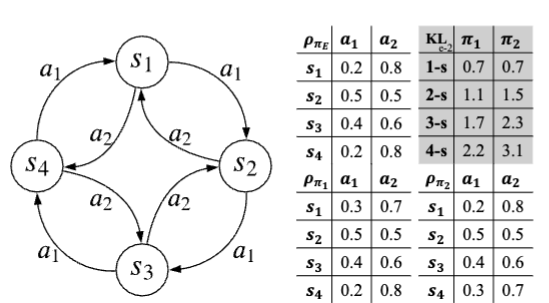
Imitation Learning via Multi-Step Occupancy Measure Matching
Minghuan Liu, Hangyu Wang, Yangtian Zhang, Minkai Xu, Zhengbang Zhu, Weinan Zhang
@article{liuautogail,
  title={Imitation Learning via Multi-Step Occupancy Measure Matching},
  author={Liu, Minghuan and Wang, Hangyu and Zhang, Yangtian and Xu, Minkai and Zhu, Zhengbang and Zhang, Weinan},
  journal={Preprint},
  year={2022}
}
04Experience
- Menlo ParkMeta · Research Scientist Intern · with Fei ShaDistilling diffusion language models for efficient generation.
- New YorkGoogle DeepMind · Student Researcher · with Jiaxin Shi & Michalis TitsiasDiscrete diffusion and learning-to-order insertion models (→ ICML'26 Spotlight).
- BeijingMicrosoft Research AI4Science · Research Intern · with Tao QinMulti-modal foundation models for scientific discovery.
- MontréalMila – Quebec AI Institute · Research Assistant · with Jian TangGeometric generative models for proteins and molecular docking; TorchDrug & TorchProtein.
- ShanghaiAPEX Lab, SJTU · Undergraduate Researcher · with Yong Yu & Weinan ZhangMulti-step imitation learning.
Education
- Yale UniversityPh.D. in Computer Science
- Shanghai Jiao Tong UniversityB.Eng. in Computer Science, ACM Honors Class · summa cum laude
Service
Reviewer for NeurIPS, ICML, ICLR, and AAAI.
05Writing
- Flow Matching: a generalized framework for diffusion models?
Continuous normalizing flows, conditional flow matching, and how they relate to diffusion.